





BLOGSDETAILS
Industrial Dust Collector Design: Complete Engineering Guide
Author:shangcheng Time:2026-10-14 21:34:54 Click:166
Proper industrial dust collector design requires balancing airflow dynamics, filtration efficiency, energy consumption, and regulatory compliance. This comprehensive engineering guide covers key design principles, calculation methods, and equipment selection criteria for optimal dust collection system performance.
Fundamental Design Parameters
1. Air-to-Cloth Ratio (A/C Ratio):
The most critical design parameter, defined as:
Typical A/C ratios by application:
| Application | A/C Ratio (ft/min) | Filter Type |
|---|---|---|
| Woodworking (sander dust) | 2.0 - 4.0 | Woven/needlefelt |
| Metals (grinding, polishing) | 3.0 - 5.0 | Needlefelt |
| Chemicals (dry powders) | 1.5 - 3.0 | Needlefelt/PTFE membrane |
| Pharmaceutical (API) | 1.0 - 2.5 | PTFE membrane |
| Food processing (flour, sugar) | 2.0 - 4.0 | FDA-compliant media |
2. Face Velocity and Can Velocity:
Face Velocity: Air velocity through filter media (ft/min), must be < media rated value to prevent blinding
Can Velocity: Air velocity inside dust collector housing (ft/min), typically 150-250 ft/min for proper settling
3. Pressure Drop Characteristics:
Clean Pressure Drop: 0.5 - 1.5" w.c. (depends on media permeability)
Operating Pressure Drop: 3 - 6" w.c. (typical design range)
Maximum Allowable: 8 - 10" w.c. (fan power limitation)
Filter Media Selection Criteria
Selecting appropriate filter media is central to industrial dust collector design:
Key Selection Factors:
Operating Temperature: Continuous and peak temperatures determine material selection (polyester to 130°C, PTFE to 260°C)
Chemical Compatibility: pH, moisture, and chemical exposure dictate fiber type and treatments
Particulate Characteristics: Size distribution, shape, and agglomeration tendency affect filtration mechanism
Emissions Requirements: Regulatory limits (e.g., MACT standards) may require membrane laminates
Abrasion Resistance: High-abrasion dusts (silica, alumina) need surface treatments or special weaves
Common Filter Media by Application:
| Media Type | Temperature Limit | Chemical Resistance | Typical Applications |
|---|---|---|---|
| Polyester (PET) | 130°C | Good (acids) | Wood, metal, general dust |
| Polypropylene (PP) | 90°C | Excellent (acids/bases) | Chemical processing |
| Acrylic | 140°C | Good (acids, some alkalis) | Cement, carbon black |
| Nomex (meta-aramid) | 200°C | Fair (acids) | Asphalt, non-ferrous metals |
| Ryton (PPS) | 190°C | Excellent (acids) | Coal-fired boilers |
| PTFE (Teflon) | 260°C | Excellent (all chemicals) | Waste incineration, chemical |
| Fiberglass | 260°C | Good (acids) | High-temperature processes |
Design Calculations and Sizing
1. Total Airflow Determination:
Where capture hood Q is calculated using:
Enclosure hoods: Q = V × A (velocity × area)
Capture hoods (freely escaping): Q = K × (D2 × Vcapture)
Slot hoods: Q = Vslot × (slot width × length)
2. Filter Area Calculation:
Convert to number of bags:
3. Fan Sizing:
Where:
Q = Airflow (CFM)
ΔP = Total pressure drop (in. w.c.)
ηfan = Fan efficiency (0.55 - 0.75)
ηmotor = Motor efficiency (0.85 - 0.95)
4. Pulse-Jet Cleaning System Sizing:
Typical bags per valve: 8-16 for 6" bag spacing, 12-20 for 8" spacing.
Compressed air requirement:
Equipment Configuration Options
industrial dust collector design involves selecting appropriate collector type:
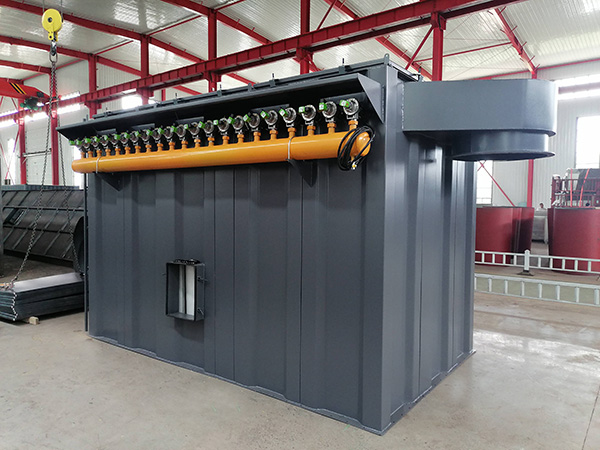
1. Baghouse Configurations:
| Type | Cleaning Mechanism | Applications | Advantages |
|---|---|---|---|
| Pulse-Jet Baghouse | High-pressure air pulse | Continuous operation | Compact, high efficiency |
| Reverse-Air Baghouse | Low-pressure reverse air | High-temperature, corrosive | Gentle cleaning, long bag life |
| Shaker Baghouse | Mechanical shaking | Intermittent operation | Simple, low cost |
2. Cartridge Collector:
Filter Area Density: 2-3x higher than baghouses (smaller footprint)
Cleaning: Pulse-jet (similar to baghouses)
Applications: Low-to-moderate dust loading, space-constrained installations
Limitations: Higher pressure drop, less suitable for high-temperature/chemical applications
3. Cyclone Pre-Separators:
Function: Remove coarse particles (>10 μm) before baghouse
Efficiency: 50-90% for 10-100 μm particles
Benefits: Reduce baghouse load, extend filter life, lower pressure drop
Compliance and Safety Considerations
industrial dust collector design must address regulatory requirements:
1. Emissions Compliance:
NSPS (New Source Performance Standards): 0.005 gr/dscf for most industries
MACT (Maximum Achievable Control Technology): Industry-specific (e.g., 0.003 gr/dscf for HCl production)
Local Regulations: May be more stringent than federal (e.g., SCAQMD Rule 1173 in Los Angeles)
2. Explosion Protection:
NFPA 68: Deflagration venting requirements
NFPA 69: Explosion prevention systems
ATEX Directive (Europe): Equipment certification for explosive atmospheres
Design Features: Explosion vents, isolation valves, suppression systems
3. OSHA Compliance:
Permissible Exposure Limits (PELs): Workplace air quality standards
Respiratory Protection: When collector efficiency insufficient
Confined Space Entry: Procedures for bag changeouts
Energy Efficiency Optimization
Optimize industrial dust collector design for energy efficiency:
1. Fan System Optimization:
Select high-efficiency fans (AMCA Class A or B)
Install variable frequency drives (VFDs) for flow control
Right-size fan for actual operating conditions (avoid oversizing)
Minimize ductwork pressure losses (smooth transitions, adequate radii)
2. Compressed Air Optimization:
Right-size pulse valves (match valve capacity to bag size)
Optimize pulse duration (100-150 ms typical)
Implement on-demand cleaning (pressure-differential-based)
Ensure dry, clean compressed air (prevent diaphragm damage)
3. Heat Recovery Opportunities:
Recover waste heat from exhaust air (if permissible)
Use heat exchangers to pre-heat incoming make-up air
Consider thermal oxidizer integration for VOC-containing streams
Installation and Commissioning Best Practices
Proper industrial dust collector design execution includes:
1. Pre-Installation Planning:
Verify equipment dimensions and clearance requirements
Confirm utility connections (electrical, compressed air, water)
Review structural supports and foundation requirements
Plan rigging and lifting paths
2. Installation Steps:
Set equipment base level and secure anchoring
Install ductwork with minimal leaks (smoke test verification)
Connect electrical per NEC and local codes
Install safety devices (pressure gauges, high-temperature alarms)
Perform leak testing (soap bubble test for air systems)
3. Commissioning Procedures:
Verify fan rotation direction and amp draw
Test pulse-jet cleaning system (timing, pressure)
Measure pressure drop across clean filter media
Conduct balance test (airflow distribution)
Perform emissions test (if required by permit)
Train operators on startup/shutdown procedures
Frequently Asked Questions
What is the typical payback period for energy-efficient dust collector design?
Energy efficiency upgrades typically pay back in 1-3 years through reduced fan power consumption (20-40% savings) and compressed air optimization (15-30% reduction). VFD installations show fastest payback (12-18 months) in variable-load applications.
How do I determine if my existing dust collector is properly sized?
Evaluate: (1) Pressure drop trend (increasing faster than expected?), (2) Emissions test results (exceeding limits?), (3) Fan power consumption (higher than design?), (4) Dust loading at discharge (visible emissions?). Conduct professional audit to quantify deficiencies.
What are the most common mistakes in industrial dust collector design?
Common errors: (1) Oversizing A/C ratio (causes high pressure drop, short bag life), (2) Undersizing fan (inadequate capture velocity), (3) Ignoring ductwork design (poor airflow distribution), (4) Inadequate access for maintenance (bag changeouts difficult).
How often should I test emissions from my dust collector?
Initial compliance test after installation/modification, then periodic testing per permit requirements (typically annually). For critical applications, conduct performance monitoring quarterly (pressure drop, visual observation). Continuous emissions monitoring (CEM) may be required for Title V permits.
Can I retrofit my existing dust collector for better performance?
Yes, common retrofits include: (1) Upgrade filter media (e.g., add PTFE membrane), (2) Install VFD on fan, (3) Retrofit pulse-jet system (add timers, optimize valve sizing), (4) Add cyclone pre-separator. Evaluate cost vs. performance improvement carefully.
Conclusion
Effective industrial dust collector design integrates aerodynamic principles, filtration science, and regulatory compliance into a cohesive system. Proper sizing of airflow, filter area, and fan power ensures reliable performance while minimizing energy consumption and maintenance costs.
Engage experienced engineering firms or dust collector suppliers with in-house design capabilities. Validate design calculations with computational fluid dynamics (CFD) modeling for complex installations. Prioritize energy efficiency and maintainability in the design phase—these decisions determine 80% of lifecycle costs.
Remember that industrial dust collector design is iterative. Monitor performance continuously, document operating parameters, and be prepared to fine-tune settings as process conditions change. Well-designed systems deliver decades of reliable service while protecting worker health and the environment.
References
American Conference of Governmental Industrial Hygienists. (2022). Industrial Ventilation: A Manual of Recommended Practice (31st Edition). ACGIH Press.
American Society of Heating, Refrigerating and Air-Conditioning Engineers. (2021). ASHRAE Handbook: HVAC Applications. ASHRAE Press.
National Fire Protection Association. (2021). NFPA 68: Standard on Explosion Protection by Deflagration Venting. NFPA.
U.S. Environmental Protection Agency. (2020). AP-42: Compilation of Air Emissions Factors. EPA Office of Air Quality Planning and Standards.
Zhang, H., et al. (2020). "Computational Fluid Dynamics Modeling of Dust Collection Systems." Journal of the Air & Waste Management Association, 70(5), 512-528.
 HOT PRODUCT
 CONTACT US